

At 43 years old I went back to school to supplement my B.A. in English Lit with a more useful Associate of Applied Sciences degree. I made a decision to carve a path to get out of the bar management business. I was chafing at the prospect of continuing into my late 40s and 50s babysitting drunk adult children.
Within 5 years I completed a 2-year degree and secured a mechanical design job at a university research laboratory.
I had carefully and successfully crafted an escape hatch from a figurative (and potentially literal) dead-end, and emerged into a world of new possibility.
Now, there’s really nothing remarkable about career pivoting in my 40s, so don’t be alarmed that I’m climbing up on a pedestal here. An action like this is practically mandatory for Gen X. Gone are the days of companies taking care of their employees with generous pensions; gone too the employee loyalty that resulted from those pensions.
What I found particularly interesting were the effects this had in other areas of my life.
I experienced an emotional transformation through divorce.
I experienced physical, psychological, and spiritual transformation on my journey to sobriety.
It would seem that by taking positive action to transform one aspect of my life, I was left no choice but to evaluate the full spectrum of my existential condition.
This was the real “light bulb” moment for me: it wasn’t about just changing what I was doing vocationally that led to a more satisfying life. I was experiencing a whole mindset shift and evolving into the next, and more gratifying phase of my life.
What I was really doing was establishing a repeatable blueprint that now serves as the basis for how I approach the next logical move into an even more meaningful stage of life: Midlife-Plus.
This is the period from our 50s to our 70s in which we can do something completely new.
Midlife Stagnation Isn’t Real
In 1958 Alfred Hitchcock, in his psychological thriller Vertigo, popularized the filming technique of the dolly zoom, also known as the “Vertigo Effect.” He used this “dolly-out/zoom-in” technique to capture the dizzying discombobulation experienced by James Stewart’s character looking down the bell tower shaft.
This dolly zoom technique has been utilized over the years to great effect. Like when Roy Scheider sees the shark for the first time in Jaws, or when government agents are looking over the hill down on Elliott’s neighborhood in E.T the Extra Terrestrial.
But my particular favorite use of the technique is in horror movies when it’s used to make the end of a hallway stretch away in the distance, the door at the end retreating, seemingly unreachable, as the victim tries to outrun the pursuer.
This is exactly how many Gen Xers feel about the retirement goal line…forever retreating into the future.
Why is that?
So many reasons. But chief among them:
1. No more pensions – as mentioned above. The late 1970s saw the corporate pension replaced by the 401k plan – secure lifetime income was replaced by a savings vehicle especially sensitive to market volatility.
2. The longevity factor – people are living longer. We’re already watching wide-eyed baby boomer retirees fret about outliving their money. Gen X may have to work well into their 70s and possibly 80s to feel secure enough to stop working.
3. Traditional retirement is dead – your parents’ model of “learn, earn, retire” that served them well (to a point) is no longer valid in a world that has dramatically changed. It’s a classic square-peg-round-hole conundrum.
And there’s another factor to consider as well, the unpredictable unknown: AI as the fourth industrial revolution.
Given the state of rapidly changing technological advancements with AI, and the pressure companies are under from share stakeholders to reduce operating margins, there’s no telling at what point the older, expensive, experienced knowledge worker will get the axe.
Let’s not get too overly dramatic about the robot uprising, but there should still be a sense of urgency to finding a better solution than traditional retirement.
The feeling of midlife stagnation is less of a dramatic collapse, and more of a slow erosion of time.
The day will come, if it hasn’t already, when you’ll quizzically furrow your brow and think “man…I thought for sure I’d be further along by now.” In all likelihood this disconnect can be traced back to our twenties. We were presented with the status quo idea of retirement as something to look forward to eventually, and probably didn’t give it much more thought at the time.
It’s really no surprise that we arrived in our fifties and realized that this way of thinking wasn’t going to work as advertised. We’re not to blame for thinking that the way it’s been done is the way we should do it too.
But the reality is we are not locked in to a particular way of approaching this problem. We don’t have to try and adapt a broken model to fit our circumstances. We can build a whole new model for how to enter our midlife-plus years.
So, what’s the alternative?
Unstick Your Thinking
Just because you haven’t thought about an alternative to retirement yet doesn’t mean you’re too late. But it is paramount to start exploring your options now.
The writing has been on the wall for some time. Especially if you waited like I did to do any serious retirement saving.
It may seem like the only option is to keep doing what you’re doing, saving as much as you can for as long as you need to, and finally calling it quits when it seems like you’ll be safe.
But what if you hate what you’re doing and can’t imagine doing it for another 25 years? Will the goal of retirement ever arrive?
Maybe. But maybe not. Maybe we’re wrong to assume retirement is a goal to be reached.
What if we approach our midlife-plus years as a whole new phase to do something new and exciting? We can use a lifetime of experience and wisdom to make money in ways that don’t involve going to a job, working for someone else, not in control of how and where we live and work.
Retirement can just be a moment we stop doing one thing and start doing another, more important and more satisfying thing.
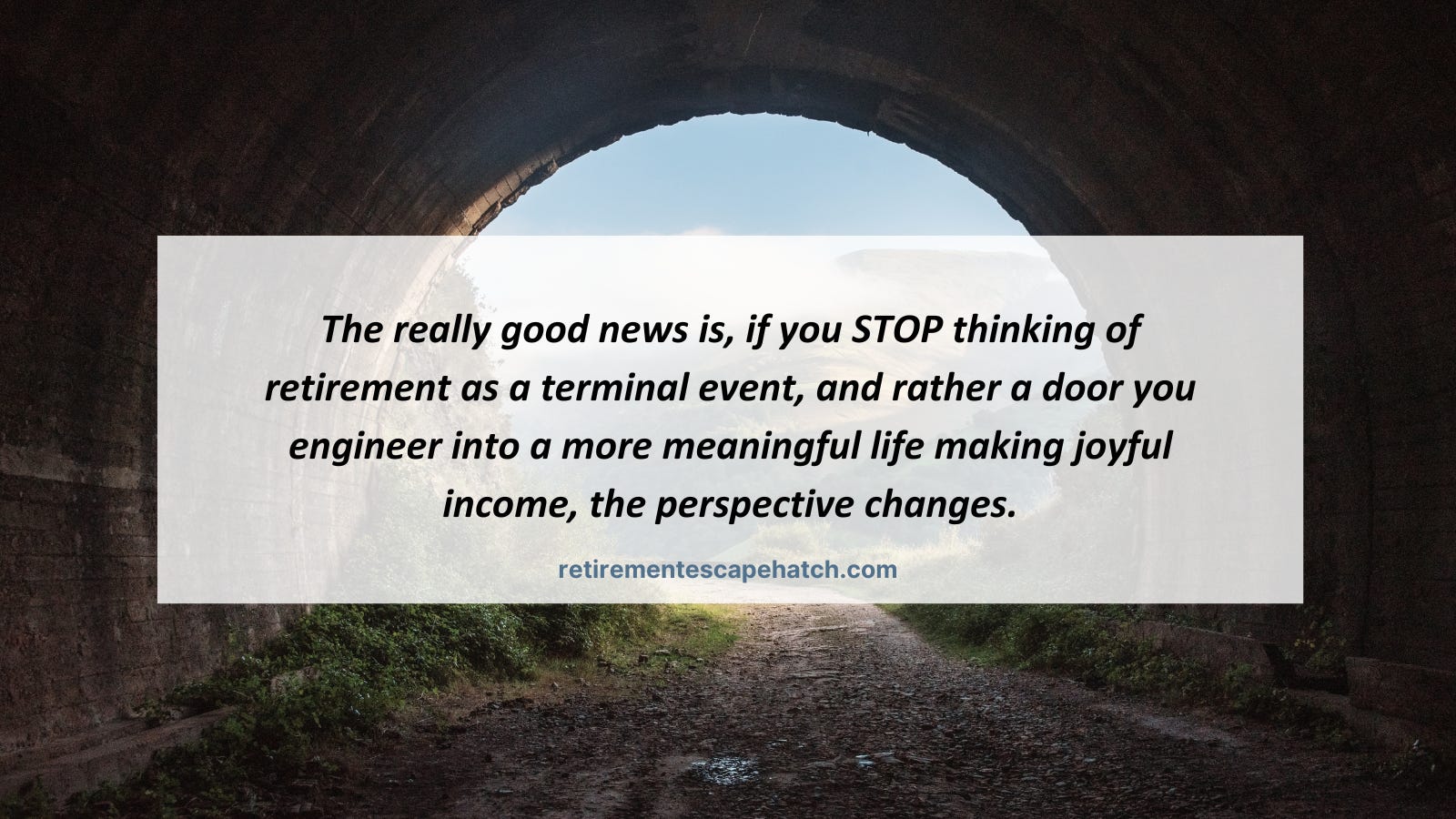
The really good news is, if you STOP thinking of retirement as a terminal event, and rather a door you engineer into a more meaningful life making joyful income, the perspective changes.
Instead of retirement as a moving finish line, it becomes a simple list of things to check off before you step through the portal you create.
Start Creating the Escape Hatch
When you know you don’t have enough to retire because you started too late, despair can percolate just below the surface at a constant simmer. You can feel like circumstances are controlling you instead of the other way around.
Instead of working for 25 more years at a job that holds you down, build a business around what you want to do instead. You can take control and regain your agency.
Plan on starting your own solo business around something that excites you. Then pay attention to how many other aspects of your life come into focus.
You will begin to feel more in control of the direction your life moves. You’ll start reclaiming agency and regaining control.
The “business” component is simply the mechanism for regaining control.
Try this little thought exercise to get the business ideas rolling when you’re out walking the dog or whatever:
My Solo Midlife Business is…
Client-Based – “Here, let me do that for you. I can do it better anyway!”
-OR-
Course-Based – “Here, let me show you how to do it so you’ll go away and leave me alone!”
This is greatly over-simplified, and it’s not really a binary choice, but it’s a really snarky Gen X way to think about it.
So let’s get to it. It’s up to us!