

In 1994, after 20 years with Rush, Neil Peart completely reinvented his drumming technique under the tutelage of noted jazz and swing instructor Freddie Gruber.
He didn’t have to. He chose to.
Think about how unusual that is. By that time he had already cemented himself as one of the greatest drummers of all time, sharing the firmament with an impressive pantheon: Buddy Rich, John Bonham, Gene Krupa, Keith Moon, Stewart Copeland…
And his compositional approach to drumming would inspire legions of future musicians, like Danny Carey of Tool, who cites Peart as a major influence for his precise, structural arrangements.
Even earlier, in 1981, the album Moving Pictures elevated Rush to a more radio-friendly prominence, while still inspiring undying allegiance in their die-hard fan base. The song Tom Sawyer became the anthem for disaffected prog-rock music geeks, and turned non-musicians into world-class air drummers.
In the late 1970s Peart was lovingly nicknamed “The Professor” by his bandmates and road crew. At first consideration, one might think this was because of his voracious appetite for literature and his deep, symbolic, analogy-rich lyrics. But it was a reference to something more mundane and less highbrow.
His serious demeanor and physical appearance reminded them of the Professor from Gilligan’s Island. Simple as that.
But musically, it was apt as hell. He approached drumming with surgical precision. He turned complex polyrhythm and odd time signatures into a science.
He was revered the world-over for his relentless dedication to the art of percussion and almost machine-like repeatability in live performance.
He was the consummate musician’s musician.
Most people would have protected that identity. Instead, he voluntarily dismantled it.
He became a student again. Not because he had failed.
Because he sensed there was still another version of himself waiting on the other side of discomfort.
Time After Time We Lose Sight of the Way
I think many people in midlife quietly feel something similar, even if we struggle to articulate it.
Outwardly, life may look stable: career, responsibilities, competence, routine.
But internally, there’s often a growing awareness that stability and aliveness are not the same thing. This is one of the hidden tensions of midlife stagnation.
People become highly skilled at maintaining a life they no longer feel deeply connected to.
And because society trains us to value stability above adaptation, many people mistake the absence of crisis for fulfillment.
But human beings are not static systems.
We either continue expanding…
…or we slowly begin contracting around familiarity.
The Broken Retirement Dream
We’ve been witnessing firsthand what is happening to the “Retirement Generation” that our parents are part of. Even those with generous pensions are careful about how they spend. They’re not traveling all the time. They watch how current political and economic chaos affects their savings.
They are also sometimes a little amazed at the extended longevity they are experiencing. I’d be willing to bet that many of them, given the opportunity, with an expectation of this extended longevity, would have relished the opportunity to reinvent themselves. To explore another path, satisfy another curiosity, before plopping in front of the TV to ride it out.
Many Gen Xers have already recognized the reality that we will not be able to retire with enough money to carry us through 30-40 more years of life on what little we have been able to save.
It is highly unlikely we will have enough by 65 to feel secure if nothing else is coming in. What’s also highly unlikely is that we will be content doing whatever it is we are doing right now for another 20 years.
What’s more likely is we will continue on, working well into our 70s, maybe beyond, because the specter of financial insecurity at the end of life is too frightening. None of us wants to be destitute at the end of life, unable to age and die with a little dignity.
What This Means For Gen X
This financial uncertainty can have the effect of pushing us into The Drift.
A drift is not always away from something. In this case it’s drifting towards familiarity. Closer in line with the status quo of “keep working at what you’re doing now and earning and saving…and then one day…?”
It’s the old adage of “if it ain’t broke, don’t fix it.”
This drift to stay more closely aligned with the status quo may result in financial security. But it will cost us some extra time to get there.
The real cost of The Drift, however, is the lost opportunity for happiness.
It’s easier to stay where it’s safe. But here’s the thing:
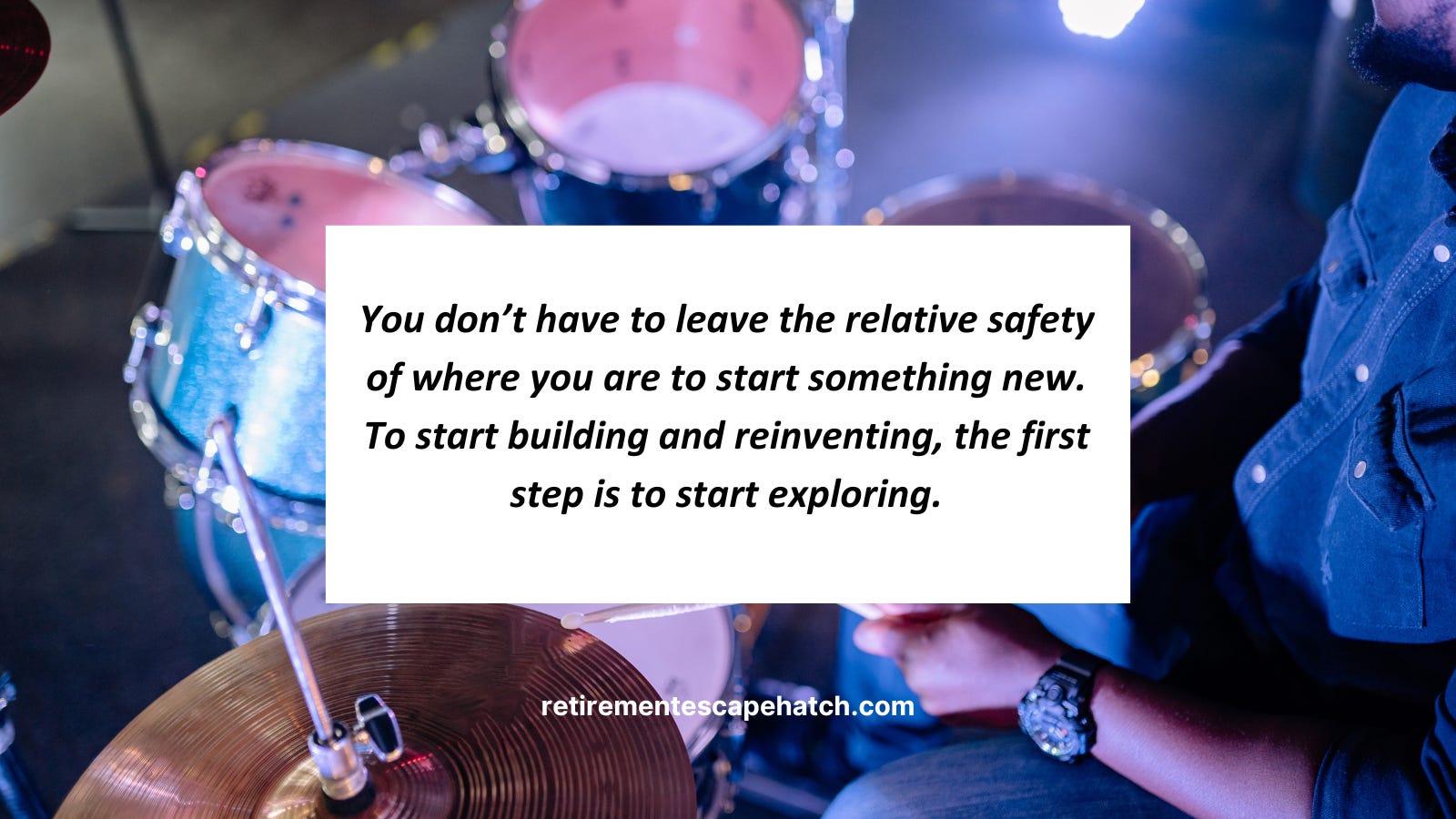
You don’t have to leave the relative safety of where you are to start something new. To start building and reinventing, the first step is to start exploring.
Starting a solo midlife business begins with honestly probing within to find not only what you want to do, but why you want to do it.
This can be a statement such as “I need to build an escape hatch out of my current job and into a solo business because I’m not willing to sacrifice my happiness for manufactured security.”
Like Simon Sinek stated in Start With Why:
People don’t buy what you do, they buy why you do it.
Finding the reason for solving a problem that is important to you is the first step in finding others who have that same reason for solving the same problem. That’s how you find the people that will pay money to have their problem solved. The people that believe what you believe.
It starts with curiosity, and is then driven by conviction.
Teaching Yourself to Become a Student (again)
This week don’t focus on building a business. Focus on becoming a student again.
Choose one area of curiosity, capability, or creativity that exists outside your current professional identity.
Then spend just 30 minutes deliberately practicing beginnerhood.
Not optimizing.
Not monetizing.
Not proving anything.
Just learning.
Examples:
Study a digital tool
Write publicly for the first time
Explore a newsletter platform
Research a niche topic
Practice explaining something you know
The goal is not immediate usefulness.
The goal is adaptation.
The first stage of reinvention is not financial. It’s neurological. You are teaching yourself that your identity is still expandable.
Reflection
Neil Peart died in 2020 at the age of 67, after quietly battling glioblastoma for three-and-a-half years.
I’ve been thinking a lot lately about how he lived his life.
He studied classic literature, science fiction, fantasy, philosophy, and nature. He consumed the works of great authors at a pace consistent with the knowledge that there would never be enough time to read it all, but try nonetheless.
He processed his view of life, society, and humankind’s place in the world through his imagery-rich lyrics.
The fluidity of his artistic process was demonstrated with the creative push and pull he had with bassist/singer Geddy Lee. Geddy would make suggestions of how the lyrics could be changed to better fit the song or better fit his singing facility.
Neil’s approach to his own creation was not immutable – he was, according to guitarist Alex Lifeson, always open to input from Geddy. He seemed to understand that life is never a completed work. Life is a continuum of creation, renewal, and reinvention.
I think that’s what resonates so deeply about stories like Neil Peart studying under Freddie Gruber.
Not the fame. Not the technical achievement. But the willingness to begin again after mastery.
That takes humility. But it also takes hope. Hope that there is still another version of yourself worth discovering beyond the routines that once defined you.
And maybe that’s what Midlife-Plus really is. Not retirement. Not withdrawal. Not endless maintenance.
But the decision to remain unfinished.
If this resonates with you, subscribe below.
I write about midlife reinvention, meaningful work, and building your escape hatch before necessity forces the issue.